| Title (alphabetical) and author. | Numbers of fragments and pages. | Other information. | Blog entry. |
| 7 Greeks, translated by Guy Davenport. | 213 fragments in 48 pages; no Greek. | Translation, essay, and notes by Guy Davenport. | Blog of Davenport's book |
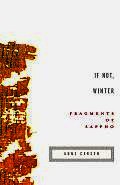
| If Not, Winter, translated by Anne Carson. | 192 fragments; Greek included. | Translation, essays, and notes by Anne Carson. 9-page glossary. | Blog of Carson's book |
| The Love Songs of Sappho, translated by Paul Roche. | 171 fragments; no Greek. | Translation and essay by Paul Roche. 12-page introduction by Page DuBois. 15-page glossary. 7-page bibliography. | Blog of Roche's book |
| Sappho and the Greek Lyric Poets, translated by Willis Barnstone. | 141 fragments occupy 10% of this 350-page book; no Greek. | Includes an essay on Sappho and a concordance. | |
| The Sappho Companion, Margaret Reynolds. | 30 fragments; Greek included. | Voluminous essay by Margaret Reynolds. 6-page bibliography. 12-page index. 7-page list of extracts. | Blog of Reynolds' book |
| Sappho to Valéry: Poems in Translation, John Frederick Nims. | 4 of the longer fragments; Greek included. | Translations of many other poets. |
Compare these translations of the first (of five) stanzas in Fragment 16. [A fragment number is shown only where a translator used a different number from that used by Anne Carson and others.]
Sequence shows the most recent first.
Anne Carson in If Not, Winter (2002) translates the first stanza as:
Some men say an army of horse and some men say an army on foot
and some men say an army of ships is the more beautiful thing
on the black earth. But I say it is
what you love.
|
Paul Roche translates this as in his poem 55, in his The Love Songs of Sappho (1998) [p. 83]:
A cavalry corps, a column of men,
A flotilla in line, is the finest thing
In this rich world to see -- for some ... but for me
It's the person you love.
|
Margaret Williamson (1995) make interesting use of square brackets to echo the losses from the original due to papyrus damage, giving this start, from The Sappho Companion (2000) by Margaret Reynolds [p. 37]:
[So]me an army on horseback, some an army on foot and some say a fleet of ship i[s] the loveliest sight o[n this] da[r]k earth; but I say it is what- ever you desire. |
David Constantine (1983) from The Sappho Companion (2000) by Margaret Reynolds [p. 36]:
Some say nothing on earth excels in beauty Fighting men, and call incomparable the lines Of horse or foot or ship. Let us say rather Best is what one loves. |
Guy Davenport in 7 Greeks (1976-1995) translates this as in his poem 25, with first stanza :
A company of horsemen or of infantry Or a fleet of ships, some say, Is the black earth's finest sight, But to me it is what you love. |
John Frederick Nims translates Sappho's first stanza as Fragment 16 in his Sappho to Valéry: Poems in Translation (1971) [p. 289]:
Some prefer a glory of horsemen; warships,
some; a phalanx, some -- as the dark horizon's
finest sight. No -- listen to me! -- the best is
what you're in love with.
|
Willis Barnstone translates Sappho's first stanza in his poem 124 thus, in his Sappho and the Greek Lyric Poets (1962, 1988) [p. 66]:
Some say cavalry and others claim infantry or a fleet of long oars is the supreme sight on the black earth. I say it is the one you love. |
|
Sections:
|
Sections:
|
Sections:
| Twelve hundred years of ancient testimony (roughly 600 B.C. to 600 A.D.) insisted that Sappho was the greatest woman poet the world had known, and, with her male contemporaries, Anacreon and Alcaeus, on of the greatest practitioners -- perhaps the greatest practitioner -- of love poetry |
|
I have arranged my Sappho
in six different "books"e;
roughly following the line of her moods
and ending with the touching nostalgia
of her middle and old age.
...
Lastly let me acknowledge that I have followed the lead of Ms. Barnard in providing headings for most of the poems and fragments. These are probabilities suggested by the context in which the poem was quoted in antiquity, or otherwise conjecture from Sappho's own background. The headings are supplementary and supply the sense of missing lines, besides giving a setting and a sequence to what otherwise would be unfocused. |
Appendix: "Some Notes on the Dilemma of Translating Sappho".
A particularly interesting and helpful section.
Includes:
| the two schemes of metric, quantity and stress, do not in fact run counter to each other, but parallel, and possess between them a perfect analogy of metric. What has been left out is ... the fact that Greek and English share ... a treasury of spoken rhymes where quantity and stress become almost interchangeable terms. ... In Greek you have schemes of quantitative rhythm which cut across the natural accents or stress values of words. In English you have schemes of stress rhythm which cut across the natural accents or stress values of the words. The difference is that in English the stress values of the syllables is not constant, whereas in Greek the quantitative value of the syllable (within certain limits) is. |
Lists 11 basic feet in Greek poetry and 13 principal meters used by Sappho.
69 pages of notes on individual translations.
Helpful in showing where the poem appeared in the Greek,
its meter in the original,
alternate readings of the Greek (if applicable),
and alternate interpretations (if applicable).
|
|
Sections:
Thirty of the 213 then-known fragments selected "to give some indication of the flavour of Sappho's work, her themes and subjects, as well as some sense of the world for which the poetry was created". The best things about this sections are:
The development of Sappho's reputation among Greeks and then Romans.
The disappearance of Sappho's poetry just before the start of the European Dark Ages. The glimpses of Sappho beginning in the Renaissance.
17th-century Sappho studies in France and Britain.
18th-century Sappho studies in France and Britain. Includes Alexander Pope.
High opinions of Sappho become expressed more widely, including by Samuel Taylor Coleridge.
Includes the direction for an play, an 18th-century ballet, and a 19th-century drama, all about Sappho.
|
|
Related pages:
Books of Poetry Form.
Alphabetic list of poetry forms and related topics.
Poetry Home-Sweet-Home.
How to Write Poetry.
|
|
Copyright © 2008 by J. Zimmerman, except for the quoted poems.
All rights reserved. |